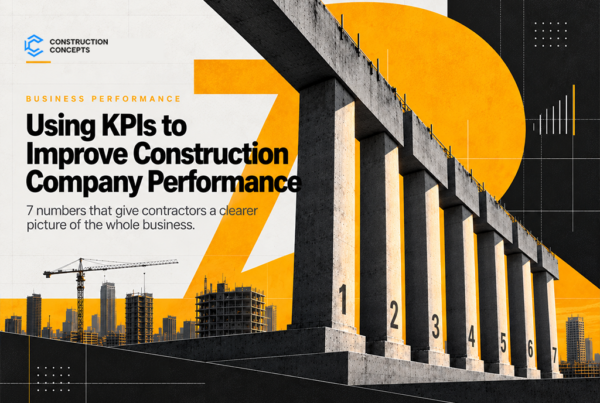


Most contractors know their numbers on a project level. Cost to complete. Change orders. Labor burn. What’s owed and what’s due.
But there’s a second set of numbers, a handful of ratios, that tell you how the company is doing, not just the job. And most owners don’t look at them until something goes wrong.
That’s the pattern we see over and over again. A company is profitable on paper, growing, busy, and still runs into a cash crunch that catches everyone off guard. Usually, the warning signs were sitting in the numbers for months. Nobody was checking.
You don’t need to become a CFO to fix this. You need five ratios, checked monthly, and the discipline to actually look at them.
Why Monthly, Not Annually
Your year-end financials tell you what already happened. By the time your CPA hands you a report in March, the problem, or the opportunity, is old news.
Construction moves fast. Jobs start and stop. Billing lags behind labor. A single large receivable can quietly reshape your whole cash position. Monthly is the rhythm that lets you catch a shift while you can still do something about it.
Think of it the same way you’d think about a safety walk. Nobody waits for the annual audit to notice a hazard on site. You check because checking regularly is what prevents the incident in the first place. Your financials deserve the same habit.
1. Working Capital
What it is: Current assets minus current liabilities.
Why it matters: This is your cushion: the money you’d have left if you had to pay off everything due in the next twelve months, right now, today. In construction, where cash flow is uneven and a slow-paying client can tie up funds for months, working capital is what keeps the lights on between draws.
What to watch: Is it shrinking month over month, even while revenue looks fine? That’s often the earliest sign that growth is outpacing cash, a good problem dressed up as a bad one.
2. Current Ratio
What it is: Current assets divided by current liabilities.
Why it matters: This tells you, at a glance, whether you can cover your short-term obligations. Most sureties and lenders want to see a ratio of at least 1.2 to 1.5, though the right number depends on your trade and your typical job cycle.
What to watch: A ratio drifting toward 1.0 or below means your liabilities are catching up to your assets, worth a conversation before it’s worth a crisis.
We can help you make informed decisions from your finances, and more.
3. Quick Ratio (the “Acid Test”)
What it is: Same idea as the current ratio, but it strips out inventory and other assets that aren’t easily converted to cash, leaving cash, receivables, and short-term investments.
Why it matters: It’s a stricter, more honest look at your liquidity. Inventory doesn’t pay a subcontractor. Cash and receivables do.
What to watch: If your current ratio looks healthy but your quick ratio looks thin, most of your “cushion” may be tied up in places that aren’t actually liquid.
4. Gross Profit Margin
What it is: Revenue minus cost of goods sold, divided by revenue.
Why it matters: This is the number that tells you whether you’re actually making money on the work, not just staying busy. Volume can hide a shrinking margin for a long time. A company can be growing top-line revenue while quietly earning less on every dollar of work.
What to watch: Track this by job, not just company-wide. A healthy overall margin can mask one or two jobs bleeding money underneath it.
5. Over/Under Billing (WIP Position)
What it is: A comparison of what you’ve billed on a job versus the actual cost and progress of the work, the heart of your work-in-progress schedule.
Why it matters: Underbilling means you’re financing the client’s project with your own cash. You’ve done the work but haven’t invoiced for it yet. Overbilling can feel like extra cash in the bank, but it’s really a liability waiting to catch up with you as costs come in.
What to watch: A WIP schedule that’s consistently underbilled across multiple jobs is one of the clearest early warnings of a cash flow problem heading your way.
Building the Habit
None of these ratios are complicated math. What’s hard is doing it consistently: pulling the numbers, sitting with them, and asking what they’re telling you, every single month, whether business is good or not.
The contractors who stay ahead of cash problems aren’t smarter than everyone else. They’re just looking sooner. Start simple. Pick one day a month, right after your books close is usually best, and run these five numbers. Compare them to last month. Compare them to the same month last year. Ask yourself what changed and why.
Your numbers are already telling you the story of your company. The only question is whether you’re reading it in time to act.
If you’re not sure where to start pulling these numbers from your current reporting, that’s a conversation worth having sooner rather than later, not after a tight month makes the decision for you.
We can help you make informed decisions from your finances, and more.